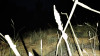
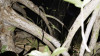
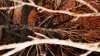
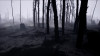
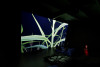
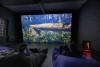
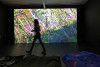
Femke Herregraven – THE EVACUATED, 18.10. – 29.11.2026, Halle für Kunst Lüneburg. Stills: Femke Herregraven, The Evacuated, 2021-2026. Installation views: Henriette Pogoda. Courtesy of the artist.
Femke Herregraven – THE EVACUATED, 18.10. – 29.11.2026, Halle für Kunst Lüneburg. Stills: Femke Herregraven, The Evacuated, 2021-2026. Installation views: Henriette Pogoda. Courtesy of the artist.
FEMKE HERREGRAVEN
THE EVACUATED
The landscapes surrounding Lüneburg are far from untouched, having been shaped by the extraction of natural resources, the establishment of military infrastructure, and the development of tourist destinations. Rather than mere backdrops, these landscapes are constructs in which political power relations, economic interests, and societal notions of nature become manifest.
In this context, the multimedia installation The Evacuated (2021–2026) by Dutch artist FEMKE HERREGRAVEN simulates a forest generated in real time by a game engine. Driven by a computational model whose rules and protocols are continuously iterated, the synthetic ecosystem undergoes endless cycles of decay, mutation, and renewal.
The work was inspired by a forest in the Netherlands that houses a gene bank for native tree and shrub species. By classifying these plants and cultivating them under strictly controlled conditions, the aim is to preserve their genetic characteristics as unchanged as possible. This reveals a fundamental paradox of nature conservation: the human impulse to protect life by fixing it in time.
The Evacuated turns this logic inside out. The computer-generated forest undermines any sense of continuity and, precisely through its instability, makes the vulnerability and ephemerality of natural habitats tangible. In doing so, the work also challenges the assumption that the future can be calculated, modelled, or predicted, proposing instead a nonlinear temporality in which past, present, and future coincide. Here, remembering does not mean preserving the past, but reflecting its aftereffects in an ever-changing present.
The title evokes the dual meaning of evacuation: to leave a place and to empty it. It thus refers to living beings and life worlds displaced by catastrophes and caught in a state of transit. In this liminal condition, the past seems irretrievably lost and the future beyond reach. The installation invites us to dwell in this uncertainty and to hold open the tension between the irreversibility of destruction and the possibility of renewal.
Curated by LISA DEML and MARIE-SOPHIE DORSCH.
The exhibition is generously funded by Stiftung Niedersachsen and the Kingdom of the Netherlands. The annual programme at Halle für Kunst Lüneburg e.V. is supported by the Ministry for Science and Culture of Lower Saxony, Lüneburgischer Landschaftsverband, and Hansestadt Lüneburg.
Femke Herregraven’s work explores the effects of abstract value systems on landscapes, ecosystems, languages, historiography, and daily life through iterative sculptures, drawings, films, and hybrid installations. A recurring theme in her research-based practice is the financialisation of the future as crisis, which she examines through catastrophe bonds as instruments for distributing potential risks and losses. Herregraven graduated in Graphic Design from ArtEZ University of the Arts in Arnhem in 2007 and in Design from the Sandberg Institute in Amsterdam in 2010. She is an alumna of the Rijksakademie van beeldende kunsten in Amsterdam and was awarded the title of Creator Doctus by the Sandberg Institute in 2024. She was shortlisted for the Prix de Rome in 2019 and received the Evens Arts Prize in 2023 and the Theodora Niemeijer Prize in 2025. Her work has been exhibited internationally, including at Sonsbeek (Arnhem, Netherlands, 2026), RADIUS – Centre for Contemporary Art and Ecology (Delft, Netherlands, 2024), Kunsthall Trondheim (Norway, 2023), Museo Reina Sofia (Madrid, Spain, 2023), Nottingham Contemporary (United Kingdom, 2021), and the 13th Gwangju Biennial (South Korea, 2021).